Puttin’ on the (Gothic) Ritz
The Phantom of the Opera opened January 26, 1988, on Broadway, becoming one of the grandest successes the Great White Way had ever seen. The classic story of a “monster” who lives in the basement of a French opera house, terrorizing everyone along the way to get to his true love, Christine Daaé. Men (including the 45th/47th President of the United States) grasped onto the story, identifying themselves with the Phantom as closely as they could. The story of Frankenstein’s Monster has always felt like the antithesis of his. A monster that man creates, who wreaks havoc amongst the people because of the surroundings in which it was brought up. The Phantom is a monster self-fulfilled. Frankenstein’s Monster is trying to find that same self-fulfillment externally. This is familiar territory for Director Guillermo del Toro. Previous films like The Shape of Water and Pinocchio have thematically emphasized humanity’s part in creating monsters. Mary Shelley’s characters fit right into his repertoire. When his thematic grip is around this Creature, it is gothic romance heaven. When it is not, the grandiose production design noticeably does the heavy lifting.
It almost seems like del Toro is so heavily focused on Elordi’s (excellent) Creature that it feels as though the first half of the film is entirely forgotten. What the film ends up feeling like is an unbalanced, absolutely gorgeous mess. Luckily, the balance tips towards excellence as soon as the Creature commands the screen. What then unfolds is a story of a sad boy who yearns for connection in a brutal world. Where the Phantom yearns for connection in violent, literally operatic ways, the Creature leans into his own self-discovery before making any rash decisions. That maturity is no match against the vitriol the cold world has for him, and the destruction Victor brings upon his own world. It unfolds like the dark, gothic fairy tale del Toro is known for. And what a world it is.

The tale begins on a stuck ship in the middle of icy nowhere. The crew of the ship discover a fire nearby, and later the limp body of Dr. Victor Frankenstein (Oscar Isaac). Right behind him is the Creature (Elordi), who attacks the crew, leading to his own perceived drowning. When Frankenstein wakes up, he is urged to tell the tale of how he got there in the first place. The film then delves into his side of the story. This is the part we are all familiar with: mad scientist looks to create life, is given money to do so, and thus the Creature is…aliveeee!!
We are also introduced to Harlander (an underutilized Christoph Waltz) and Elizabeth (Mia Goth, who is fantastic in what is ultimately an undercooked character). They both serve as catalysts for why Frankenstein has the means for creating the Creature and how the Creature ends up finding a connection in the world. As Victor’s world eventually burns up around him, we are thrust back into the ship. The Creature has (of course) survived and is on the hunt for Frankenstein. When he approaches the cabin, he exclaims his need to discuss his side of the story. This is where the story takes off, and discovering this piece is not worth spoiling in a review.
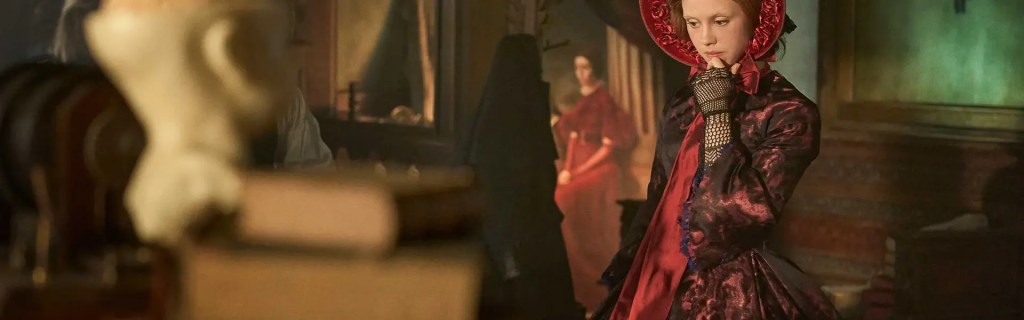
An unsung hero of any Guillermo film is the production design, and this is no exception. I would even go so far as to say this is one of the most beautifully designed films I have seen in a long time. Tamara Deverell has crafted sets that feel like you are in the fairy tale, even when the plot feels a little shallow. Each scene a page turn into the next. Kudos to the Art Direction team of Marilou Vaillancourt, Brandon Gordon, Celestria Kimmins, and Emer O’Sullivan for their execution as well. Kate Hawley’s Costume Design is also a highlight, especially for Mia Goth’s Elizabeth. Every design made Elizabeth look like a painting in the best way. We see the same beauty as the Creature. A nice touch.
It is a shame that the first half of the film merely exists instead of popping off the screen. Isaac and Waltz provide competent performances, but remain stuck on a one-note theme of “humans are the bad guys!” I wish they extracted more from these characters like Goth does. Her Elizabeth seems to be written like a damsel waiting to be taken away by the forbidden love of her Creature. What she pulls out is tenderness and yearning from things other than her desire to be with the Creature. That love she holds happens to be another facet of her, instead of her whole being. The Creature understands this more fully as he obtains his “education”. Their love has surprising emotional maturity and patience. That angle they decide on is what carries a lot of the best moments towards the end of the film.
Instead of leading with violence and a “taking” attitude like our Phantom friend, Elordi’s Creature leads with humanity and a “giving” touch. Yes, humans can be monsters. Humans can also be, well, humans.
The Bottom Line: 3.78/5
Running Time: 150 minutes. Rated R.
5 Films You Should Watch If You Liked Frankenstein
- Phantom Thread (2017)
- The Phantom of the Opera (2004)
- Election (1999)
- Call Me By Your Name (2017)
- Tim Burton’s Corpse Bride (2005)

 Really Tall Guy